What Constitutes a Biblical Day?
Why the day begins at evening — a scriptural examination of three witnesses that establish sunset-to-sunset reckoning throughout Scripture
Introduction
One of the most foundational questions in understanding Yahuah’s appointed times is deceptively simple: When does a day begin? Most people raised in a modern Western context instinctively think of midnight as the start of a new day. Others assume the day begins at sunrise. But neither of these lines up with what Scripture actually teaches.
This matters enormously for feast observance, for Sabbath keeping, and for every appointed time on the biblical calendar. If the day begins at midnight, the Sabbath starts at midnight Friday and ends at midnight Saturday. But Scripture consistently shows us a third pattern: the biblical day begins at evening — specifically, at sunset.
We are not seeking to convince you through tradition or opinion. We want to go to the Word itself. As the Bereans did, let’s examine the Scriptures together (Acts 17:11) and study to show ourselves approved (2 Timothy 2:15).
Common Questions About the Biblical Day
These are the questions we hear most often about when a biblical day begins:
“Doesn’t a day start at midnight? That’s how our Gregorian calendar works.”
“If the day starts at evening, why do some groups begin their Sabbath at sunset while others begin it at nightfall? Is there a difference?”
“What does the Bible mean by ‘between the evenings’ or ‘at twilight’? What time is that exactly?”
“How did ancient Israel count the hours of the day? What does ‘the ninth hour’ mean in the New Testament?”
The answer to all of these questions is found in Scripture itself. Let’s examine THREE WITNESSES that establish beyond reasonable doubt when the biblical day begins — but first, let’s understand the Hebrew word for “day.”
Understanding “Yom” — The Hebrew Word for Day
Yom (יוֹם) = the Hebrew word for “day”H3117
Yom Word Study:
Hebrew: יוֹם (Yom)
Strong’s: H3117
Hebrew Letters: Yod (י) – Vav (ו) – Mem (ם)
Pictographic Meaning: Yod = hand/work, Vav = nail/connect, Mem = water/mighty — the span of a completed cycle of time
Primary Definition: A day;H3117 can refer to the daylight portion alone (contrasted with night),H3915 or to the full 24-hour period. Context determines which usage applies.
Why does this matter?
Yom is used both ways throughout Scripture. When referring to the full day in the context of Yahuah’s appointed times and the creation pattern, it always begins with the evening. The 12-hour daylight portion of yom runs from dawn to dusk. But the complete 24-hour day runs from evening to evening.
The Hebrew understanding of a complete day is not midnight-to-midnight or sunrise-to-sunrise. It is evening-to-evening.
With this foundation, let’s now examine the three scriptural witnesses that confirm when the biblical day begins.
WITNESS ONE: The Creation Pattern
Genesis 1:5, 8, 13, 19, 23, 31
Six times in the creation account, Yahuah gave us the foundational pattern for how a day is reckoned.
The Refrain of Creation — Six Times Without Exception:
Each of the six creation days concludes with the same phrase, establishing an unbreakable pattern:
The Hebrew Text:
וַיְהִי-עֶרֶב וַיְהִי-בֹקֶר
Vayehi erev, vayehi voker — “And there was erevH6153 (evening), and there was bokerH1242 (morning)”
The Critical Observation:
- Evening is mentioned FIRST — before morning, in every single instance
- This is not incidental phrasing. The order is the pattern: evening begins the day
- If the day began at midnight, we would expect “there was morning and there was evening”
- If the day began at sunrise, each creation day would open with “morning”
- But six times, without exception, it is EVENING first
Key Word Studies:
Erev (עֶרֶב) — Strong’s H6153: Evening,H6153 sunset, the going down of the sun. Root meaning: to mix or mingle, describing the blending of light and darkness at sunset.
Boker (בֹּקֶר) — Strong’s H1242: Morning,H1242 dawn, the breaking of the day. Root meaning: to split open, as the darkness is split open by the first light of dawn.
Yahuah established the order at creation itself: Evening → Night → Morning → Daytime → Evening again.
∴ From the very first chapter of Scripture, Yahuah established that a day runs from EVENING through MORNING — evening comes first.
WITNESS TWO: The Feast Commands — “From Evening to Evening”
Leviticus 23:32 • Exodus 12:18 • Deuteronomy 16:6
When Yahuah commanded how to observe His appointed times, He made the evening-to-evening structure unmistakably explicit.
The Most Direct Statement in All of Scripture:
“It is a sabbath of rest for you, and you shall afflict your souls; on the ninth dayH3117 of the month at evening,H6153 from eveningH6153 to evening,H6153 you shall celebrate your sabbath.”
— Leviticus 23:32
This is as plain as language allows. Yahuah did not leave any ambiguity: the day of observance runs from evening to evening. This is not interpretation — it is direct instruction.
Unleavened Bread Confirmation — Exodus 12:18:
“In the first month, on the fourteenth dayH3117 of the month at evening,H6153 you shall eat unleavened bread, until the twenty-first day of the month at evening.H6153”
The feast begins at evening and concludes seven days later, also at evening. Both bookends are evening. This structure only makes sense if the day itself is an evening-to-evening unit.
Pesach Sacrifice Timing — Deuteronomy 16:6:
“…there you shall sacrifice the Passover at twilight [bein ha-arbayim], at the going down of the sun, at the time you came out of Egypt.”
Bein ha-arbayim (בֵּין הָעַרְבָּיִם) — H6153 (derived): literally “between the two evenings”H6153
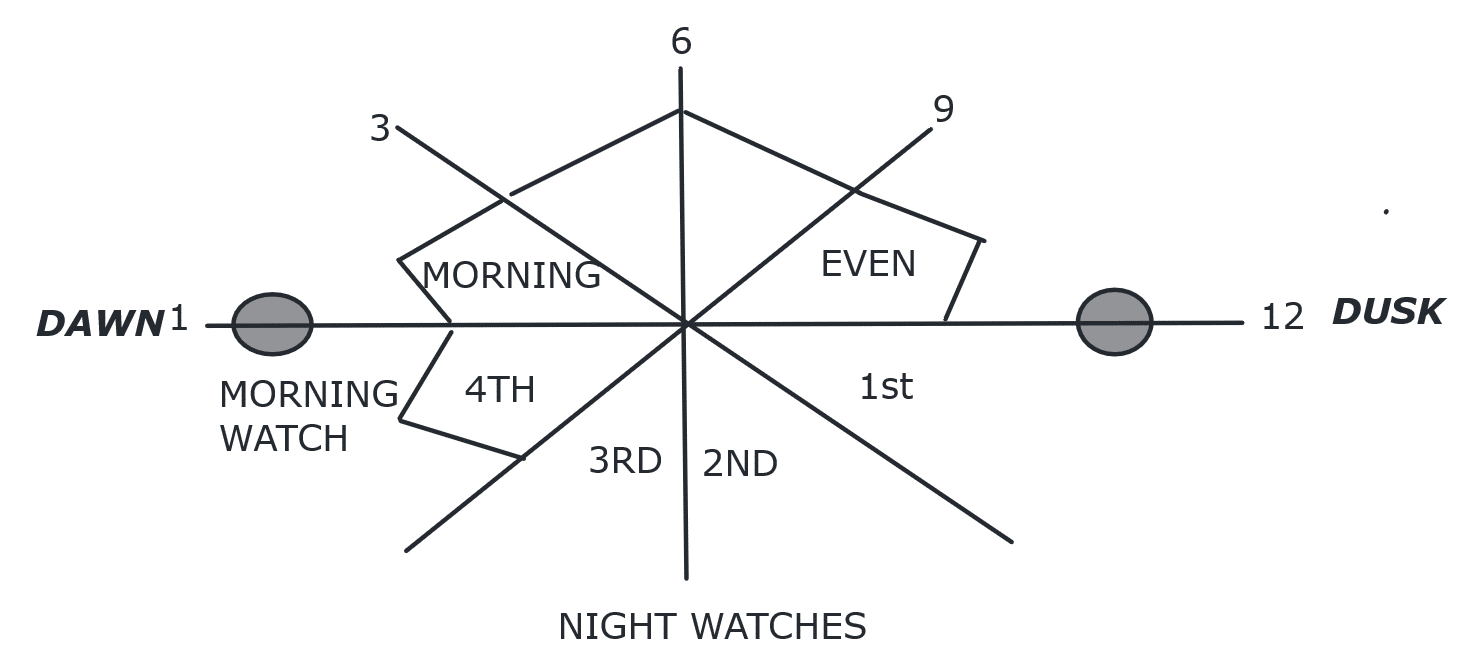
This is the period shown in the diagram as “EVEN” — the afternoon period when the sun begins its visible descent toward the horizon (approximately the 6th to the 9th hour of the day). The Pesach lamb was to be slaughtered during this window, just before the new day (Abib 14) would begin at sundown. Understanding when bein ha-arbayim falls requires understanding the structure of the biblical day.
“From evening to evening” (Leviticus 23:32) — Yahuah said it plainly. We simply believe it.
∴ Yahuah’s own instructions for His appointed times confirm: days run from EVENING to EVENING.
WITNESS THREE: The Sabbath — Observed from Sunset
Nehemiah 13:19 • Mark 1:21, 32 • Leviticus 22:6-7
Historical practice, prophetic action, and purity law all testify: the day transitions at sunset.
Nehemiah Shuts the Gates — Nehemiah 13:19:
“So it was, at the gates of Jerusalem, as it began to be dark before the Sabbath, that I commanded the gates to be shut, and charged that they must not be opened till after the Sabbath.”
Nehemiah shut the city gates as it “began to be dark” — at the onset of sunset. This is when the Sabbath began. This is not rabbinical tradition; this is the governor of Jerusalem acting on the plain understanding of when the Sabbath begins: at darkness, at sunset.
After the Sabbath — Mark 1:21, 32:
In Mark 1, Yeshua taught in the synagogue on the Sabbath (verse 21). Then:
“At evening,H6153 when the sun had set, they brought to Him all who were sick and those who were possessed with demons.” (Mark 1:32)
Why did the people wait until evening to bring the sick? Because it was the Sabbath and healing/carrying on the Sabbath would have been a violation. When the sun set, the Sabbath was over and the new day (the first day of the week) had begun. Sunset is the unmistakable transition point.
Purification at Sunset — Leviticus 22:6-7:
“…he shall be unclean until evening. He shall not eat of the holy offerings unless he washes his body with water. And when the sun goes down, he shall be clean, and afterward he shall eat of the holy offerings.”
Uncleanness lasts “until evening.” The phrase “when the sun goes down” in verse 7 is the plain explanation of “until evening” in verse 6. These two phrases are used as synonyms, confirming that evening = the going down of the sun = the beginning of the clean new day.
Three independent texts — prophetic history, New Testament narrative, and Torah purity law — all testify to the same truth: the day transitions at sunset.
∴ From the creation week to the feast commands to Nehemiah’s gates to the Levitical code — Scripture is unanimous: the biblical day begins at EVENING (sunset).
THE STRUCTURE OF THE BIBLICAL DAY
Understanding the Hours, the Periods, and the Night Watches
The following diagram, used in our assembly teaching, illustrates how a complete biblical 24-hour day is structured:
The complete biblical day begins at DUSK (sunset/evening) and concludes at the following DUSK.
PART ONE: The Daytime Hours
From Dawn (Hour 1) to Dusk (Hour 12)
The daytime portion of the biblical day runs from dawn (sunrise) to dusk (sunset) — twelve hours. This is confirmed directly in Scripture and rooted in the creation design, where Yahuah said the luminaries would be for “signsH226 and seasonsH4150” (Genesis 1:14):
📖 John 11:9:
“Yeshua answered, ‘Are there not twelve hours in the day? If anyone walks in the day, he does not stumble, because he sees the light of this world.’”
The day has twelve hours. They run from Hour 1 (dawn) through Hour 12 (dusk).
How Hours Were Counted:
Unlike our fixed 60-minute hours, biblical hours divided the daylight period equally into twelve parts. In practice, this means the length of a “biblical hour” varied by season (longer in summer, shorter in winter), but the structure was always 12 hours of daytime and 12 hours of nighttime.
- 1st Hour = Approximately sunrise / dawn
- 3rd Hour = Approximately 9 AM in modern terms (mid-morning)
- 6th Hour = Approximately noon / midday
- 9th Hour = Approximately 3 PM (mid-afternoon)
- 12th Hour = Approximately sunset / dusk
Scriptural Examples of Hour References:
Acts 2:15 — “For these are not drunk, as you suppose, since it is only the third hour of the day.” (Peter at Pentecost — roughly 9 AM)
Matthew 27:45 — “Now from the sixth hour until the ninth hour there was darkness over all the land.” (Noon to approximately 3 PM)
Matthew 20:3, 5-6 — The parable of workers hired at “the third hour,” “the sixth and ninth hour,” and “the eleventh hour” — confirming the 12-hour daytime structure.
Acts 10:9 — “About the sixth hour, Peter went up on the housetop to pray.” (Midday prayer)
The Two Daytime Periods: MORNING and EVEN
As shown in the diagram, the daytime hours are broadly divided into two periods, each referenced extensively in Scripture:
MORNING (BokerH1242)
בֹּקֶר — Strong’s H1242
The early portion of the daylight hours, from dawn through approximately the 6th hour (noon). This is the primary period of activity, sacrifice, and prayer in the Tanakh.
Genesis 19:27; Exodus 29:39; Numbers 28:4; Psalm 5:3; 88:13
EVEN / Between the Evenings
בֵּין הָעַרְבָּיִם — H6153 (derived)H6153
The afternoon period, from approximately the 6th hour (noon) until sunset. Literally “between the two evenings” — the time when the sun begins descending until it fully sets. This is when the Pesach lamb was slaughtered.
Exodus 12:6; 16:12; 29:39; 30:8; Numbers 9:3; 28:4
PART TWO: The Night Watches
From Dusk (Evening) to Dawn — Four Watches of Three Hours Each
The nighttimeH3915 portion of the biblical day is divided into four watches, each approximately three hours long. The day begins with the 1st Watch (immediately after sunset) and ends with the 4th Watch / Morning Watch (just before dawn).
Mark 13:35 — “Watch therefore, for you do not know when the master of the house is coming — in the evening, at midnight, at the crowing of the rooster, or in the morning”
Yeshua’s own words name all four night watches in sequence: evening (1st Watch), midnight (2nd Watch), crowing of the rooster (3rd Watch), morning (4th Watch/Morning Watch).
The Evening Watch
Dusk → ~9 PM
Begins at sunset, when the new biblical day begins. This is the time of the evening sacrifice and the lighting of the menorah in the Tabernacle/Temple.
Lamentations 2:19 — “Arise, cry out in the night, at the beginning of the watches”
The Midnight Watch
~9 PM → Midnight
The middle of the night. Yahuah struck down the firstborn of Egypt “at midnight” during this watch (Exodus 12:29), on the very night the Pesach began.
Exodus 12:29 — “And it came to pass at midnight that Yahuah struck all the firstborn”
The Crowing Watch
Midnight → ~3 AM
Named for the crowing of the rooster, which typically occurs in the third watch. Gideon’s famous night assault on Midian began “at the beginning of the middle watch” (Judges 7:19) — the third watch.
Judges 7:19 — “…at the beginning of the middle watch”
The Morning Watch
~3 AM → Dawn
Also called the “morning watch” in Scripture. This is when Yahuah looked down from the pillar of fire at the Egyptian army (Exodus 14:24). Yeshua walked on water to the disciples during this watch (Matthew 14:25).
Exodus 14:24 — “Now it came to pass, in the morning watch, that Yahuah looked down…”
The Complete Biblical Day — In Order:
- Dusk / Sunset — The new day begins (Evening, beginning of the 1st Night Watch)
- 1st Watch — Evening (~6 PM to ~9 PM)
- 2nd Watch — Midnight (~9 PM to ~Midnight)
- 3rd Watch — Crowing of the rooster (~Midnight to ~3 AM)
- 4th Watch / Morning Watch — Just before dawn (~3 AM to ~6 AM)
- Dawn / Sunrise — The daytime portion of the same day begins
- Morning — Hours 1 through 6 (dawn to noon)
- Even / Between the Evenings — Hours 6 through 12 (noon to dusk)
- Dusk / Sunset — The day ends; the next day begins
THE PRACTICAL IMPACT
What Evening-to-Evening Reckoning Means for Us
Understanding the biblical day has immediate, practical consequences for how we observe Yahuah’s appointed times:
The Sabbath
The Sabbath (7th day) begins at sunset on the 6th day (what the Roman calendar calls Friday evening) and ends at sunset on the 7th day (Saturday evening). This matches Nehemiah 13:19 and Mark 1:32 precisely.
Pesach
Pesach begins on Abib 14 at the going down of the sun. The lamb is slaughtered “between the evenings” (afternoon of Abib 14) and the Passover meal is eaten after sunset — which is already Abib 15 (Leviticus 23:5-6).
Yom Kippur
Leviticus 23:32 says the affliction begins on the 9th day “at evening” and runs to the evening of the 10th day. The fast begins at sunset on what we would call the evening before Yom Kippur (Day 10).
All Feast Days
Every appointed time begins at sunset the evening before. When our calendar shows “Abib 15,” the observance actually begins at the sunset that ends Abib 14 — not at midnight, not at sunrise.
“We don’t go by the Gregorian clock. We go by what the SCRIPTURE says and what the LUMINARIES show us.”
ADDRESSING THE MODERN ASSUMPTION
Why Midnight Is a Roman Convention, Not a Biblical One
The Assumption:
“A new day starts at midnight. That’s just how it works.”
The Problem with Midnight:
The midnight-to-midnight day is a Roman civil invention, not a biblical one. The Romans divided the day using this system for administrative and legal purposes. This convention was inherited by Western civilization through the Roman Empire and the Julian/Gregorian calendar system.
What Scripture Never Does:
- Scripture never says a day begins “at midnight” in a calendrical sense
- Scripture never uses midnight as the marker for when a new date begins
- Every explicit command about when a day or feast begins points to evening / the going down of the sun
✗ Midnight reckoning ignores Leviticus 23:32 (“from evening to evening”)
✗ Midnight reckoning ignores Genesis 1 (evening first, six times)
✗ Midnight reckoning contradicts Nehemiah 13:19 (gates shut at darkness = Sabbath beginning)
✗ Midnight reckoning is a pagan Roman civil convention, not a Hebraic one
✗ Midnight reckoning causes believers to miss the true beginning of Sabbath and every feast
✓ The Biblical Method
Watch for the sun to set.
When the sun goes below the horizon, the new biblical day has begun. This is:
- What Genesis 1 establishes (evening before morning)
- What Leviticus 23:32 commands (“from evening to evening”)
- What Nehemiah practiced (shutting the gates as darkness fell)
- What the disciples understood (waiting until sunset when the Sabbath ended)
- What the luminaries in the sky show us — no calculation needed
We simply observe what Yahuah placed in the sky to tell us when time changes.
IN SUMMARY
Scripture establishes a consistent, unmistakable pattern across multiple books and contexts:
Evening begins the day — not midnight, not sunrise
Morning follows the night — just as Genesis 1 shows
Dusk begins the next day — just as Leviticus 23:32 commands
The biblical day runs from sunset to sunset — evening to evening.
Our Three Witnesses Confirmed:
- WITNESS ONE (Genesis 1:5-31): Six times at creation, evening is named before morning. The day begins at evening.
- WITNESS TWO (Leviticus 23:32; Exodus 12:18): The feast commands explicitly say “from evening to evening.” No ambiguity.
- WITNESS THREE (Nehemiah 13:19; Mark 1:32; Leviticus 22:6-7): Historical practice, New Testament narrative, and purity law all confirm: the day transitions at sunset.
Those who begin the Sabbath or feast days at midnight are following a Roman civil convention — not the biblical pattern.
We understand that many sincere believers have simply never been taught the biblical day — because most of Western Christianity inherited the Roman calendar without examining it against Scripture. We bear no condemnation toward those who are still learning. We simply ask: what does the Word say?
We Invite You to Examine Scripture for Yourself:
Don’t take our word for it. Open Genesis 1. Read Leviticus 23:32. Look at Nehemiah 13:19 and Mark 1:32. The evidence is right there (Acts 17:11; 2 Timothy 2:15). Let the Word speak for itself.
These are APPOINTED TIMES — appointments with Abba Yahuah Himself. We want to arrive at the right time, not the Roman time. Evening-to-evening reckoning is not our tradition; it is Scripture’s consistent testimony from Genesis to the New Testament.
📖 Continue this study: How Yah’s Appointed Times Are Determined →
“It is a sabbath of rest for you, and you shall afflict your souls; on the ninth day of the month at evening, from evening to evening, you shall celebrate your sabbath.”
— Leviticus 23:32