First Fruits:
A Closer Look at One of Scripture’s Most Beautiful Moments
What it is, when it falls, and what it points to
Introduction
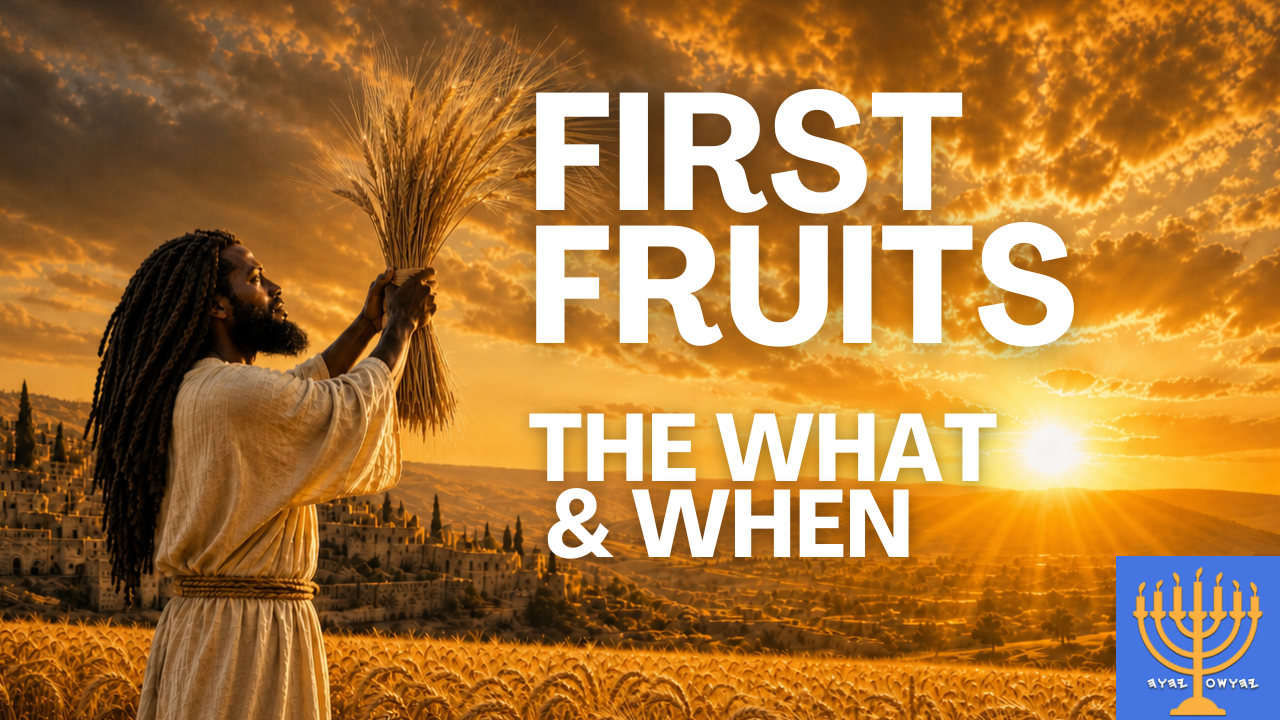
At some point during Unleavened Bread, a priest would walk out to a field before sunrise, cut a bundle of the first ripe grain, bring it before Yahuah, and wave it. That was it. No elaborate ceremony. No weeks of preparation. Just a sheaf of grain lifted before the Creator of the universe — and by that act, the entire harvest was consecrated and released.
Centuries later, on the exact day that ordinance prescribed, Yahusha HaMashiach walked out of a tomb.
First Fruits tends to get overshadowed by Passover and Unleavened Bread — but it shouldn’t. It is the day the shadow became substance. It is the hinge the whole spring feast season turns on. And every year it raises the same sharp questions: When exactly is it? Why that day and not another? What are we supposed to do? This article answers all of it — from the Hebrew text up, nothing added, nothing assumed.
First Fruits 2026
Begins at sunset
Saturday, May 9
Saturday, May 9
Continues through sunset Sunday, May 10
Why May 9 at sunset? Three reasons Scripture makes plain:
1
The weekly Shabbat within ULB ends at May 9 sunset.
ULB — the Feast of Unleavened Bread — is the 7-day feast that begins at sunset on the 15th of Abib. The weekly Shabbat that falls within those 7 days ends at May 9 sunset. First Fruits is the morrow after that Shabbat — so it begins the moment that Shabbat closes.
ULB — the Feast of Unleavened Bread — is the 7-day feast that begins at sunset on the 15th of Abib. The weekly Shabbat that falls within those 7 days ends at May 9 sunset. First Fruits is the morrow after that Shabbat — so it begins the moment that Shabbat closes.
2
There is only ever one Shabbat within a 7-day feast.
ULB is 7 days. The Shabbat cycle is every 7 days. Exactly one weekly Shabbat falls within ULB — never two, never zero. There is only one candidate. There is no debate.
ULB is 7 days. The Shabbat cycle is every 7 days. Exactly one weekly Shabbat falls within ULB — never two, never zero. There is only one candidate. There is no debate.
3
The Shabbat of May 1–2 ends before ULB opens.
It cannot be the anchor. That Shabbat belongs to the week before the feast — not within it. Counting it would give you two Shabbats inside ULB, which is impossible.
It cannot be the anchor. That Shabbat belongs to the week before the feast — not within it. Counting it would give you two Shabbats inside ULB, which is impossible.
The Feast Season at a Glance
Pesach
14th of Abib
Preparation & meal
(not a feast day)
▶
Unleavened Bread
15th–21st of Abib
7 days
▶
First Fruits
Day after Shabbat
within ULB
▶
50-Day Count
Omer count
begins here
▶
Shavuot
50th day
Always a Sunday
First Fruits is the hinge between Unleavened Bread and Shavuot — anchored to the weekly Shabbat within ULB, it launches the 50-day omer count.
In This Article
- The 2026 Calendar — Day by Day
- Is First Fruits an Appointed Time (Moed)?
- When Scripture Says First Fruits Is
- Does First Fruits Involve Barley?
- The First Fruits Offering: Then and Now
- Yahusha — The Ultimate Fulfillment of First Fruits
- The 50-Day Omer Count
- What Does “First Fruits” Mean? — A Hebrew Word Study
- Common Questions
- Summary
1. The 2026 Calendar — Day by Day
Walk through this year’s calendar sunset by sunset. This year has a special configuration — the weekly Shabbat falls on the final day of ULB — which makes it an especially clear teaching moment.
2026 Passover Season — Sunset-to-Sunset Calendar
| Hebrew Day Runs… | Civil Date | Day of Week | What Day Is It? |
|---|---|---|---|
| Thu Apr 30 sunset → Fri May 1 sunset | Fri May 1 | Friday | Regular day — pre-feast week |
| Fri May 1 sunset → Sat May 2 sunset | Sat May 2 | Saturday | Weekly Shabbat The Shabbat BEFORE ULB. Ends before ULB opens. |
| ▼ Sat May 2 at Sunset — Weekly Shabbat ENDS & ULB Day 1 BEGINS simultaneously ▼ | |||
| Sat May 2 sunset → Sun May 3 sunset | Sun May 3 | Sunday | ULB Day 1 High Day First day of Unleavened Bread |
| Sun May 3 sunset → Mon May 4 sunset | Mon May 4 | Monday | ULB Day 2 |
| Mon May 4 sunset → Tue May 5 sunset | Tue May 5 | Tuesday | ULB Day 3 |
| Tue May 5 sunset → Wed May 6 sunset | Wed May 6 | Wednesday | ULB Day 4 |
| Wed May 6 sunset → Thu May 7 sunset | Thu May 7 | Thursday | ULB Day 5 |
| Thu May 7 sunset → Fri May 8 sunset | Fri May 8 | Friday | ULB Day 6 — Preparation day |
| Fri May 8 sunset → Sat May 9 sunset | Sat May 9 | Saturday | ULB Day 7 High Day Weekly Shabbat Double Convocation The ONE Shabbat within ULB — Lev 23:11. |
| ▼ Sat May 9 at Sunset — ULB ENDS & Weekly Shabbat ENDS & First Fruits BEGINS ▼ | |||
| Sat May 9 sunset → Sun May 10 sunset | Sun May 10 | Sunday | First Fruits “The morrow after the Shabbat” — Lev 23:11. Day 1 of the Omer. |
The dark teal rows mark the two key sunset transitions. Everything flows from these.
The “Double Convocation” — What That Means This Year
Something special happens this year: the weekly Shabbat and ULB Day 7 fall on the exact same Hebrew day — Friday May 8 sunset to Saturday May 9 sunset. Both the High Day rest and the weekly Shabbat rest fall simultaneously.
The Double Convocation — May 8 Sunset to May 9 Sunset
ULB Day 7
Final High Day of Unleavened Bread
Final High Day of Unleavened Bread
Weekly Shabbat
Regular seventh-day rest
Regular seventh-day rest
FRI MAY 8 SUNSET → SAT MAY 9 SUNSET
Both the High Day rest and the weekly Shabbat rest fall on this single Hebrew day
Both the High Day rest and the weekly Shabbat rest fall on this single Hebrew day
The double convocation does not change the count. It confirms it.
Why May 3rd Does Not Work
The argument for May 3rd: “Saturday May 2 is the weekly Shabbat. The day after it is Sunday May 3. Therefore First Fruits is May 3.” Here is what is actually happening at May 2 sunset:
At May 2 sunset, two things happen simultaneously:
1. The weekly Shabbat (May 1 sunset → May 2 sunset) ENDS
2. Unleavened Bread Day 1 BEGINS
1. The weekly Shabbat (May 1 sunset → May 2 sunset) ENDS
2. Unleavened Bread Day 1 BEGINS
The Shabbat of May 1–2 ends before ULB opens — it belongs to the week before, not within the feast. Leviticus 23:11 is anchored to the Shabbat that falls during the feast, not the one that precedes it.
Why First Fruits Steps Just Outside ULB — And Why That Is Perfectly Fine
An Important Scriptural Point
Nowhere in Scripture does it say that First Fruits must fall within the seven days of Unleavened Bread. Read Leviticus 23:9–16 carefully — that requirement simply is not there.
What Scripture requires is only this: find the weekly Shabbat that falls during those seven days of ULB. That Shabbat is the anchor. The morrow after it is First Fruits — wherever it lands. The only anchor point is the Shabbat within the feast.
This year First Fruits begins at May 9 sunset — the same moment ULB ends. First Fruits steps just outside ULB by one day. That is not an error. That is simply how the calendar falls in 2026, and the text of Lev 23:11 is fully and precisely satisfied.
The Handoff — ULB Ends as First Fruits Begins
ULB Day 7
Fri May 8 sunset
→ Sat May 9 sunset
High Day + Weekly Shabbat
Fri May 8 sunset
→ Sat May 9 sunset
High Day + Weekly Shabbat
SAT
MAY 9
SUNSET
MAY 9
SUNSET
First Fruits
Sat May 9 sunset
→ Sun May 10 sunset
Day 1 of the Omer
Sat May 9 sunset
→ Sun May 10 sunset
Day 1 of the Omer
What Lev 23:11 requires
The weekly Shabbat falls within ULB — and it does (Day 7, May 8–9). The morrow after it is First Fruits. Scripture says nothing about First Fruits itself being within ULB.
The weekly Shabbat falls within ULB — and it does (Day 7, May 8–9). The morrow after it is First Fruits. Scripture says nothing about First Fruits itself being within ULB.
What this means in 2026
The Shabbat within ULB ends May 9 sunset. First Fruits begins that same sunset. ULB and First Fruits share a boundary — they do not overlap, and that is fine.
The Shabbat within ULB ends May 9 sunset. First Fruits begins that same sunset. ULB and First Fruits share a boundary — they do not overlap, and that is fine.
Lev 23:11 requires the Shabbat to fall within ULB. It does. The morrow after it is First Fruits. The text is satisfied.
A Sincere but Common Misreading — Why Some Arrive at May 3
The heart behind the May 3 position is right — those who hold it are genuinely trying to follow Lev 23:11. The error comes down to one thing: mixing up civil calendar thinking with Hebrew sunset-to-sunset reckoning.
Where the May 3 Reasoning Goes Wrong
✗ The May 3 Reasoning
1
“Saturday May 2 is the weekly Sabbath” — thinking in civil calendar terms
2
“The day after Saturday May 2 is Sunday May 3” — so First Fruits = May 3
3
Uses the Shabbat that ends BEFORE ULB opens — not a Shabbat within ULB
4
Would require TWO Shabbats within ULB — impossible in a 7-day feast
✗ Civil calendar thinking, not Hebrew reckoning
✓ Hebrew Reckoning
1
The Shabbat runs Fri May 1 sunset → Sat May 2 sunset — ENDS at May 2 sunset
2
ULB Day 1 BEGINS at that same May 2 sunset — simultaneously
3
That Shabbat ends BEFORE ULB — it cannot be the Shabbat of Lev 23:11
4
The ONE Shabbat within ULB is May 8–9. Morrow after it = May 10. ✓
✓ One feast. One Shabbat within it. First Fruits: May 10.
The Key: What does “Saturday May 2” mean in Hebrew reckoning?
In civil terms, “Saturday May 2” is a calendar square. In Hebrew terms, the Shabbat runs from Friday May 1 sunset → Saturday May 2 sunset. At May 2 sunset: Shabbat closes and ULB simultaneously opens. That Shabbat belongs to the week before the feast.
In civil terms, “Saturday May 2” is a calendar square. In Hebrew terms, the Shabbat runs from Friday May 1 sunset → Saturday May 2 sunset. At May 2 sunset: Shabbat closes and ULB simultaneously opens. That Shabbat belongs to the week before the feast.
Seven days. One Shabbat inside them. The math settles it.
2. Is First Fruits an Appointed Time (Moed)?
A moed(H4150) is “an appointed time, a fixed meeting point between Yahuah and His people.” A mikra kodesh(H4744, H6944) is a “holy convocation” — a commanded assembly of the congregation. Leviticus 23 assigns these designations deliberately. Look at what receives them and what does not:
| Observance | Called a Moed | Holy Convocation | Reference |
|---|---|---|---|
| Weekly Shabbat | Yes (v.2) | Yes (v.3) | Lev 23:2–3 |
| Pesach | Yes (v.4) | Implied | Lev 23:5 |
| Unleavened Bread — Day 1 | Yes | Yes (v.7) | Lev 23:6–7 |
| Unleavened Bread — Day 7 | Yes | Yes (v.8) | Lev 23:8 |
| Wave Sheaf / First Fruits | Not labeled | Not assigned | Lev 23:9–14 |
| Shavuot | Yes | Yes (v.21) | Lev 23:15–21 |
| Yom Teruah | Yes | Yes (v.24) | Lev 23:23–25 |
| Yom Kippur | Yes | Yes (v.27) | Lev 23:26–32 |
| Sukkot — Day 1 | Yes | Yes (v.35) | Lev 23:33–35 |
| Shemini Atzeret | Yes | Yes (v.36) | Lev 23:36 |
The wave sheaf ordinance is clearly given by Yahuah — it opens with “And Yahuah spoke to Moses saying.” It is purposeful and meaningful. But the text does not attach a mikra kodesh to it. It is a priestly ordinance — an act performed by the kohen(H3548) at the sanctuary on behalf of the people — not a commanded congregational assembly in the same category as the seven major feasts.
The Textual Verdict
First Fruits is Yahuah-commanded, scripturally significant, and prophetically profound. But Leviticus 23 does not assign it a mikra kodesh(H4744). Recognizing this frees us to honor the day for exactly what it is — without adding requirements the text itself does not place there.
3. When Scripture Says First Fruits Is
The simple answer: First Fruits is always the day after the weekly Shabbat that falls during the Feast of Unleavened Bread. The Feast of Unleavened Bread begins at sunset on the 15th of Abib — the same sunset that closes the 14th of Abib. The 14th is the preparation day: the lamb is selected on the 10th of Abib (Exodus 12:3), kept and inspected through the 14th (Exodus 12:6), slaughtered at twilight as the 14th draws to a close (Exodus 12:6; Numbers 9:3; Deuteronomy 16:6), and the Pesach meal is eaten that night — which is already the beginning of the 15th and the opening of the Feast of Unleavened Bread (Exodus 12:8). That closing sunset opens the 15th and begins ULB. From First Fruits, we count fifty days to Shavuot.
The Scriptures That Establish This
“Speak to the people of Yashar’el and say to them, when you come into the land that I give you and reap its harvest, you shall bring a sheaf of the firstfruits(H7225) of your harvest to the priest, and he shall wave the sheaf(H6016) before Yahuah, so that you may be accepted. On the day after the Sabbath(H7676) the priest shall wave it.”
— Leviticus 23:10–11
— Leviticus 23:10–11
“You shall count for yourselves from the day after the Sabbath(H7676), from the day that you brought the sheaf of the wave offering: seven complete Sabbaths(H7676) shall there be. Count fifty days to the day after the seventh Sabbath(H7676); then you shall offer a new grain offering to Yahuah.”
— Leviticus 23:15–16
— Leviticus 23:15–16
Two verses. One anchor: the weekly Shabbat(H7676) that falls during ULB. The day after it is First Fruits. From that same day we count fifty days to Shavuot. The entire spring feast calendar hangs on that one Shabbat.
A note about Yahusha’s specific timeline: Yahusha was indeed the fulfillment of First Fruits — he rose from the dead on the wave sheaf day. But we are not trying to reconstruct the exact calendar week of his death and resurrection each year, because that specific year’s configuration does not recur on a fixed pattern. What we do is follow the Torah ordinance as Yahuah gave it: find the weekly Shabbat within ULB, and observe First Fruits the following morning. Some years that day aligns closely with other commemorations; some years it does not. The ordinance itself is what we follow — not a year-specific reconstruction. We will say more about Yahusha as the ultimate fulfillment of First Fruits in Section 7.
The Sequence From Start to Finish
Here is the complete chain so you can see how each piece connects to the next:
The Full Sequence — From Pesach to Shavuot
1
Pesach Preparation — the 14th of Abib
The lamb is selected on the 10th of Abib (Exodus 12:3) and kept until the 14th (Exodus 12:6). It is slaughtered at twilight(H6153) — bein ha’arbayim, “between the evenings” — as the 14th draws to a close (Exodus 12:6; Numbers 9:3). Deuteronomy 16:6 confirms: “at the going down of the sun(H8121).” The roasted lamb is then eaten that same night (Exodus 12:8) — which is already the opening of the 15th.
The lamb is selected on the 10th of Abib (Exodus 12:3) and kept until the 14th (Exodus 12:6). It is slaughtered at twilight(H6153) — bein ha’arbayim, “between the evenings” — as the 14th draws to a close (Exodus 12:6; Numbers 9:3). Deuteronomy 16:6 confirms: “at the going down of the sun(H8121).” The roasted lamb is then eaten that same night (Exodus 12:8) — which is already the opening of the 15th.
2
Unleavened Bread begins — 15th of Abib at sunset
The sunset that ends the 14th opens the 15th — and the Feast of Unleavened Bread begins. This is the first High Day of ULB. Leviticus 23:6 — “on the fifteenth day of the same month is the Feast of Unleavened Bread(H4682).”
The sunset that ends the 14th opens the 15th — and the Feast of Unleavened Bread begins. This is the first High Day of ULB. Leviticus 23:6 — “on the fifteenth day of the same month is the Feast of Unleavened Bread(H4682).”
3
The weekly Shabbat falls somewhere within the 7 days of ULB
Since ULB is exactly 7 days and the Shabbat cycle is every 7 days, exactly one weekly Shabbat always falls within the feast — never zero, never two. This is the Shabbat Leviticus 23:11 refers to.
Since ULB is exactly 7 days and the Shabbat cycle is every 7 days, exactly one weekly Shabbat always falls within the feast — never zero, never two. This is the Shabbat Leviticus 23:11 refers to.
4
First Fruits — the day after that Shabbat (always a Sunday)
“On the day after the Sabbath(H7676) the priest shall wave it.” Leviticus 23:11. This is always the first day of the week — a Sunday beginning at the preceding Saturday sunset.
“On the day after the Sabbath(H7676) the priest shall wave it.” Leviticus 23:11. This is always the first day of the week — a Sunday beginning at the preceding Saturday sunset.
5
Count 50 days from First Fruits → Shavuot
“Count fifty days to the day after the seventh Sabbath.” Leviticus 23:16. Seven complete Sabbath cycles from First Fruits always land on a Sunday — and Shavuot (the 50th day) is always a Sunday as well.
“Count fifty days to the day after the seventh Sabbath.” Leviticus 23:16. Seven complete Sabbath cycles from First Fruits always land on a Sunday — and Shavuot (the 50th day) is always a Sunday as well.
Every step flows directly from Torah. Pesach → ULB → Shabbat within ULB → First Fruits → 50-day count → Shavuot.
Before we can apply this sequence to specific dates, we need to understand two foundational things: how Hebrew days are reckoned, and which “Sabbath” Leviticus 23:11 is actually referring to. Getting these right makes the calendar clear.
Hebrew Days: Sunset to Sunset
Hebrew days do not start at midnight like our civil calendar. They start at sunset. Genesis 1 establishes this — “and there was evening(H6153) and there was morning(H1242)” — evening is named first because that is when the new day begins.
How a Hebrew Day Works — Sunset to Sunset
Previous Day…afternoon
SUNSET
NEW DAY BEGINSEvening → Night
Continues…Morning → Afternoon
SUNSET
Next Day begins…
A Hebrew day runs from one sunset to the next. “Saturday” in Hebrew reckoning begins at Friday sunset and ends at Saturday sunset — the opposite of how we often think about it.
When we say “the Shabbat of May 8–9” we mean: the day running from Friday May 8 sunset to Saturday May 9 sunset. That is one Hebrew day. This distinction is what resolves most of the confusion around First Fruits dates.
Which Sabbath Does Lev 23:11 Mean?
Leviticus 23:11 says the wave sheaf is offered “on the day after the Sabbath(H7676).” The entire dating question turns on one thing: which Sabbath?
There are two possible answers, and they produce two different dates:
The Golden Rule of First Fruits
ULB is 7 days long.
The weekly Shabbat comes every 7 days.
Therefore — there is always exactly one Shabbat within ULB.
The weekly Shabbat comes every 7 days.
Therefore — there is always exactly one Shabbat within ULB.
Not two. Not zero. One. Every single year, without exception. This means you never have to debate which Shabbat Leviticus 23:11 means — there is only ever one candidate. Find the single weekly Shabbat that falls within the seven days of ULB. That is the Shabbat. The morrow after it is First Fruits.
✗ If you count May 2’s Shabbat…
You would have TWO Shabbats within the feast — May 1–2 and May 8–9. That is impossible. ULB is only 7 days long.
You would have TWO Shabbats within the feast — May 1–2 and May 8–9. That is impossible. ULB is only 7 days long.
✓ The Shabbat of May 8–9…
Falls within ULB. It is the one and only weekly Shabbat inside the feast. Lev 23:11 points here — and nowhere else.
Falls within ULB. It is the one and only weekly Shabbat inside the feast. Lev 23:11 points here — and nowhere else.
Seven days. One Shabbat. The math settles the question before the debate begins.
Which Sabbath Does Lev 23:11 Mean?
✗ Pharisaic / Rabbinic View
1
“The Sabbath” = the High Sabbath — the first day of Unleavened Bread (Nisan 15)
2
First Fruits always falls on Nisan 16, regardless of the day of the week
3
This means First Fruits can fall on any day — Monday, Thursday, Saturday…
✗ This is rabbinic tradition, not the plain reading of the Hebrew text
✓ Plain-Text / Biblical View
1
“The Sabbath” = the regular weekly seventh-day Shabbat that falls during ULB
2
First Fruits always falls the day after that weekly Shabbat — always a Sunday
3
This makes the 50-day omer count to Shavuot mathematically consistent every year
✓ Confirmed by Lev 23’s own vocabulary and the count to Shavuot
AOY follows the plain-text reading: “the Sabbath” in Lev 23:11 is the weekly seventh-day Shabbat. First Fruits always falls on a Sunday.
Lev 23 Uses Two Different Hebrew Words — and That Is the Proof
One of the strongest witnesses to the plain-text reading is found within Leviticus 23 itself. The same chapter uses two distinct words for two different kinds of rest — and it uses them consistently:
| Hebrew Word | Strong’s | Meaning | Used In Lev 23 |
|---|---|---|---|
| שַׁבָּת — Shabbat | H7676 | The weekly seventh-day Sabbath | vv. 3, 11, 15, 16 — always the weekly Sabbath |
| שַׁבָּתוֹן — Shabbaton | H7677 | A special high-day rest; NOT the weekly Sabbath | vv. 24, 32, 39 — always a High Day |
Every time Leviticus 23 assigns the rest of a High Day — Yom Teruah (v.24), Yom Kippur (v.32), Sukkot’s first and last days (v.39) — it uses shabbaton(H7677). Every time it refers to the weekly Sabbath, it uses shabbat(H7676). Leviticus 23:11 uses shabbat(H7676) — the weekly Sabbath word. The word choice is the witness. The text did not make a mistake.
Plain reading of Lev 23:11: “The morrow after the shabbat(H7676)” means the day after the weekly seventh-day Sabbath that falls within the Feast of Unleavened Bread — placing First Fruits consistently on the first day of the week, Sunday.
The Count to Shavuot Seals It
“You shall count from the day after the Sabbath(H7676), from the day you brought the wave sheaf: seven complete Sabbaths(H7676) shall there be. Count fifty days to the day after the seventh Sabbath(H7676).”
— Leviticus 23:15–16
— Leviticus 23:15–16
The word shabbat(H7676) appears three times in two verses. If First Fruits could land on any day of the week (as the rabbinic view allows), “seven complete Sabbaths” would produce an inconsistent result each year. But if First Fruits always falls on Sunday, then seven complete Sabbath cycles always land on Sunday too — and Shavuot (the fiftieth day) is always a Sunday. The math only works cleanly with the weekly Sabbath reading. The text is internally consistent, and that is by Abba’s design.
4. Does First Fruits Involve Barley?
Leviticus 23:10 does not name the specific grain of the wave sheaf(H6016). The text says “a sheaf of the firstfruits(H7225) of your harvest(H7105).” We should be honest: the Torah does not say “bring a sheaf of barley.” But Scripture itself — without any outside help — tells us exactly what grain was in the ear at Passover time.
“The flax and the barley(H8184) were struck down, for the barley(H8184) was in the ear and the flax was in bud. But the wheat(H2406) and the emmer were not struck down, for they are late in coming up.”
— Exodus 9:31–32
— Exodus 9:31–32
The sixth plague struck in early spring — the same season as Passover. Barley(H8184) was already in the ear. Wheat(H2406) was still immature. Canaan shared the same agricultural cycle. Barley ripens first; wheat comes later. Ruth confirms it:
“And they came to Bethlehem at the beginning of barley(H8184) harvest… She kept close, gleaning until the end of the barley(H8184) and wheat(H2406) harvests.”
— Ruth 1:22; 2:23
— Ruth 1:22; 2:23
Ruth arrived at the beginning of barley harvest — Passover season. She gleaned through barley first, then wheat — which corresponds to Shavuot. The feast calendar and the land’s harvest calendar are one and the same. Scripture maps them together without any outside help.
The honest conclusion: Lev 23:10 does not say “barley.” But the agricultural testimony of Exodus 9:31–32 and Ruth 1–2 places the wave sheaf squarely in barley harvest season. This is Scripture’s own witness — not tradition layered on top.
5. The First Fruits Offering: Then and Now
What did the First Fruits offering actually involve? And what does it look like to honor this day when its original ceremony cannot be performed as written?
What the Biblical Offering Required
Leviticus 23:10–14 and Deuteronomy 26:1–11 describe the original offering. Reading carefully, it required four things that are specific to their original context:
The land of Yashar’el — Lev 23:10 opens: “when you come into the land(H776) that I give you.” Land-contingent from its very first word.
A standing grain harvest — An actual harvest(H7105) physically reaped(H7114) from a real field.
A Levitical priest — The kohen(H3548) waves the sheaf (Lev 23:11). A priestly act, not a lay congregation observance.
The sanctuary of Yahuah — Waved before Yahuah at His dwelling. Deut 26:2 specifies “the place that Yahuah your Elohim will choose.”
Notice what Deuteronomy 26’s basket contains: the fruit of the ground(H6529) — produce from the land. Not money. The original First Fruits offering was agricultural and priestly. No passage in the 66 books commands a monetary offering specifically on First Fruits day.
Honoring First Fruits Today
Without the land, the priesthood, and the Temple, the original wave sheaf ceremony cannot be performed as written. This is not failure — it is honest. And Yahuah, who knows the end from the beginning, has not left us without meaning on this day.
Simply recognizing the day is an act of worship. To pause and acknowledge what it is — to study the Hebrew, to begin counting the omer toward Shavuot, to speak of Yahusha’s resurrection as the fulfillment of the wave sheaf — is to honor Abba’s design with your whole attention. That is beautiful. That matters.
Giving on this day is a worthy response — never a burden. The eternal spirit behind the wave sheaf is that all increase belongs to Yahuah first. If you want to give on this day as an expression of gratitude and consecration, that is a lovely act of worship in the spirit of Deuteronomy 26. Whether it is financial, service, time, or the quiet offering of your whole life before Him — Abba sees the heart(H3820). That is what He has always been after.
Why the First — and Why the Best?
The wave sheaf was not just the first grain. It was specifically the finest grain — the most fully ripened, the choicest of the harvest. Understanding why Yahuah asks for this takes us to the very beginning of Scripture.
“Honor Yahuah with your wealth and with the firstfruits(H7225) of all your produce; then your barns will be filled with plenty, and your vats will be bursting with wine.”
— Proverbs 3:9–10
— Proverbs 3:9–10
The Hebrew word here is reshith(H7225) — not just the first in sequence but the chief, the finest, the most honored portion. Yahuah is not asking for the leftovers. He is asking to be acknowledged as the source before the blessing is enjoyed.
The reason behind this is profound and simple: everything already belongs to Him. The rain that watered the barley, the soil it grew in, the sun that ripened it — none of that came from human hands. The farmer tends and plants, but Yahuah gives the increase. Recognizing Him with the first is not a loss. It is an honest accounting of reality — and an act of trust that He will provide more.
Three Reasons the First Matters
PRIORITY
It says Yahuah comes before everything else — before our own enjoyment, before our plans, before we know how the rest of the harvest will turn out.
TRUST
Giving before you know what remains is an act of faith. It says: I believe Yahuah will provide. Deuteronomy 26’s declaration — “a wandering Aramean was my father…” — is a public statement of trust built on the memory of His past faithfulness.
HONOR
The best goes first. Not the bruised grain, not the undersized stalks, not the leftovers of what you planned to keep anyway. The finest portion first — because that is what Yahuah deserves, and because what you give first reveals what you actually value most.
The spirit of these three principles runs from the wave sheaf all the way through to how we order our lives before Yahuah today.
The contrast between Cain and Abel in Genesis 4 shows what is at stake. Abel brought the firstborn(H1060) of his flock and their fat portions — the finest. Cain brought an offering from the fruit of the ground, but the text says nothing about it being first or best. Yahuah regarded Abel’s offering and not Cain’s. The difference was not the type of offering. It was the heart behind it — whether Yahuah received the best or what was merely convenient. First Fruits is Yahuah’s annual invitation to choose differently than Cain.
The original offering was grain from a field, waved by a priest in Yahuah’s sanctuary. That ceremony pointed to something far greater. Yahusha has fulfilled what the wave sheaf could only shadow. What remains for us is a heart fully given — offered before Him with thanksgiving and wonder. Not the leftovers. The first. The best.
Related Study
Yahusha fulfilled the wave sheaf as the ultimate Firstfruits. In the same way, He fulfilled the Passover lamb — His sacrifice is complete and final. So why do we still observe Pesach without slaughtering a lamb? Scripture answers this directly.
For the Children
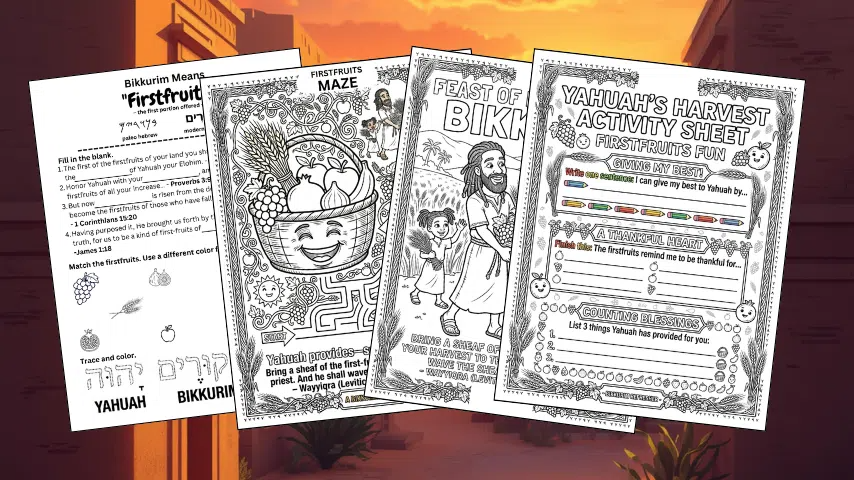
Firstfruits (Bikkurim) Activity Sheets
Bring the beauty of First Fruits to life with this hands-on activity packet! From fill-in-the-blank and coloring pages to thankfulness reflection and mazes, children will discover what it means to give Yahuah their very first and very best — and connect the harvest to Yahusha, the Firstfruits.
6. Yahusha — The Ultimate Fulfillment of First Fruits
Here is where it all lands. Every grain harvest in Yashar’el. Every dawn when a priest walked into a field and cut the first sheaf. Every time the omer was lifted and waved before Yahuah. All of it — every single wave offering across centuries — was pointing at one morning. One tomb. One moment when the Father accepted the offering and the harvest was released.
The New Covenant Scriptures do not hint at this. They declare it directly:
“But now Messiah has been raised from the dead, the firstfruits(G536) of those who have fallen asleep.”
— 1 Corinthians 15:20
— 1 Corinthians 15:20
Shadow and Substance — The Wave Sheaf Fulfilled
The Shadow
The Wave Sheaf
A bundle of grain cut from the harvest and waved before Yahuah by the priest. Had to be accepted before the rest of the harvest could be eaten.
The Substance
Yahusha’s Resurrection
The firstfruits(G536) of those who sleep. Had to be received by the Father before those who belong to Him could be gathered in.
“But each in his own order: Messiah the firstfruits(G536), then at His coming those who belong to Messiah.”
— 1 Corinthians 15:23
— 1 Corinthians 15:23
The Greek word aparchē (G536) is the precise rendering of Hebrew bikkurim (H1061). The thread runs unbroken from Leviticus 23 to the morning of the resurrection.
Yahusha rose on the wave sheaf day — the day after the weekly Shabbat within Unleavened Bread. He is the omer(H6016) — the sheaf brought before the Father. The same logic that governs the wave sheaf governs the resurrection: the offering had to be accepted before the harvest could be used. Yahusha had to be received by the Father before those who belong to Him could be gathered in. He is not merely like the firstfruits. He is the firstfruits. The wave sheaf ceremony was not a ritual pointing vaguely heavenward — it was a preview, detailed and precise, of a specific morning that would come centuries later.
“Of His own will He brought us forth by the word of truth, that we might be a kind of firstfruits(G536) of His creatures.”
— James 1:18
— James 1:18
“And we ourselves, who have the firstfruits(G536) of the Spirit, groan inwardly as we wait eagerly for adoption as sons, the redemption of our bodies.”
— Romans 8:23
— Romans 8:23
We are firstfruits. Not metaphorically — the text says it plainly. We are those brought forth by the word of truth, consecrated, set apart, waved before Yahuah in the Beloved. The thread runs from a barley field in ancient Yashar’el, through the book of Ruth, through a tomb on a Sunday morning, all the way to us. We are the harvest His resurrection releases. And every year when the wave sheaf day comes around, we are not just observing a calendar date — we are standing inside a story that was written before any of us arrived.
7. The 50-Day Omer Count
First Fruits does not stand alone. It begins something. From the morning the wave sheaf is presented, the people of Yahuah count fifty days — one day at a time — until Shavuot. This is the counting of the omer(H6016). It is not an agricultural bookkeeping exercise. It is the calendar of redemption, counting from Yahusha’s resurrection to the giving of the Spirit.
The 50-Day Omer Count — First Fruits to Shavuot 2026
Day 1 of the Omer
First Fruits — May 10, 2026
First Fruits — May 10, 2026
Day 50 — Shavuot
Begins sunset Sat June 27 — Observed Sun June 28, 2026
Begins sunset Sat June 27 — Observed Sun June 28, 2026
1
2
3
4
5
6
7
8
9
10
11
12
13
14
15
16
17
18
19
20
21
22
23
24
25
26
27
28
29
30
31
32
33
34
35
36
37
38
39
40
41
42
43
44
45
46
47
48
49
50
Day 1 — First Fruits (May 10)
Weekly Shabbat (every 7th day)
Regular omer day
Day 50 — Shavuot (begins June 27 sunset)
Weekly Shabbat (every 7th day)
Regular omer day
Day 50 — Shavuot (begins June 27 sunset)
Seven complete Shabbats (days 7, 14, 21, 28, 35, 42, 49) bring us to Shavuot on Day 50 — always beginning at Saturday sunset, observed Sunday. The count to Shavuot only works consistently with the Sunday-based First Fruits reading.
Why 50 days — not 49, not 99? Leviticus 23:15–16 gives two parallel descriptions of the same count: “count seven complete Sabbaths” (= 49 days) and “count fifty days to the day after the seventh Sabbath.” These are not two separate counts added together (49 + 50 = 99). They describe the same span from two angles — one counting the weeks, one naming the finish line. Day 50 is the day after the seventh Shabbat. That is Shavuot. The Greek name Pentecost means “fiftieth” — the feast named itself after the count. Some have read these two phrases as sequential and arrived at 99 days, but no ancient community — and no Hebrew or Greek text — supports a 99-day count. The count is 50 days, and the math only works consistently when First Fruits always falls on a Sunday.
Related Study
The unbroken weekly Sabbath cycle is the backbone of the omer count. For a deep scriptural study showing how Yahuah’s Sabbath cycle has run continuously and consistently from creation — and why it cannot be reset or restarted — see:
→ A Consistent Sabbath Cycle: A Myriad of Biblical Witnesses
Begin counting on the evening of May 9, 2026. Each day of the omer is a day of expectant waiting — not empty waiting, but counting. The number matters. The progression matters. We are walking, day by day, from the resurrection of the firstfruits toward the gift of the Spirit — tracing the footsteps of the disciples who did not yet know what was coming on the fiftieth day.
8. What Does “First Fruits” Mean? — A Hebrew Word Study
English translations collapse several distinct Hebrew words under the single phrase “first fruits.” Each carries its own shade of meaning. When we slow down and look at the Hebrew, the theology embedded in the language opens up.
Bikkurim — Primary Word for First Fruits
בִּכּוּרִים
H1061 — bikkurim
H1061 — bikkurim
“First fruits; the first ripe of grain, fruit, or produce.” Plural of bikkur, from the root bakar(H1069) — “to be early; to bear early fruit; to give the birthright” (BDB). Used in Numbers 28:26, Exodus 23:16, Nehemiah 10:35, and throughout the Torah to describe the category of first-harvest consecration. Note: the specific word used in Leviticus 23:10 for “firstfruits” is H7225 (reshith), addressed in the next card.
Reshith — The First of the First
רֵאשִׁית
H7225 — reshith
H7225 — reshith
“Beginning; the first in place, time, or rank; the chief portion.” Exodus 23:19 pairs it with bikkurim — “the reshith bikkurim(H7225, H1061) of your land” — forming a superlative: the very first of the first. The choicest portion comes before all else, to Yahuah.
Omer — The Specific Sheaf
עֹמֶר
H6016 — omer
H6016 — omer
“A sheaf; a bundle of cut grain stalks; also a dry measure equal to one-tenth of an ephah.” In Leviticus 23:10–15, the omer(H6016) is the specific unit brought — a bundle of freshly cut grain from the standing harvest, not processed or stored. Raw, living, just-reaped grain. This same word names the fifty-day count: the Counting of the Omer.
Nuwph — To Wave Before Yahuah
נוּף
H5130 — nuwph
H5130 — nuwph
“To wave; to swing; to move to and fro before.” The priest waves(H5130) the sheaf before Yahuah — presenting it, consecrating it, acknowledging His ownership before a single kernel is consumed (Leviticus 23:11). Verse 12 adds that on that same day a lamb without blemish(H8549) is also offered as a burnt offering alongside the wave sheaf — the ceremony was not the sheaf alone. Leviticus 23:14 then makes the significance explicit: “You shall eat neither bread nor grain parched or fresh until this same day, until you have brought the offering of your Elohim.” The waving releases the harvest for human use.
Together: bikkurim(H1061) names the category (first ripe produce belonging to Yahuah); reshith(H7225) intensifies the priority (the choicest of the first); omer(H6016) names the physical form (a sheaf of cut grain); and nuwph(H5130) names the priestly act (waving before Yahuah’s face). Four threads woven into one fabric — and that fabric, as we will see, points directly to Yahusha.
9. Common Questions
These are the questions that come up most often. Short answers here — the longer explanations are in the sections above.
Is First Fruits on May 3 or May 10 in 2026?
May 10 — but more precisely, First Fruits begins at sunset on Saturday May 9. By the time Sunday morning arrives, First Fruits has already been underway since the previous evening. The day runs from May 9 sunset to May 10 sunset.
Why not May 3? Saturday May 2 is the weekly Shabbat — isn’t May 3 the day after it?
The Shabbat of May 1–2 ends at the exact same moment ULB begins — both happen at May 2 sunset. That means that Shabbat belongs to the week before the feast, not within it. And since there is only ever one Shabbat within a 7-day feast, counting that one would give you two Shabbats inside ULB — which is impossible. The Shabbat within ULB is May 8–9. The morrow after it is First Fruits.
Does First Fruits have to fall within the seven days of ULB?
No. Read Leviticus 23:9–16 carefully — that requirement is simply not there. What Scripture requires is that the weekly Shabbat that anchors the count falls within ULB. The morrow after that Shabbat is First Fruits wherever it lands. This year it steps just outside ULB by one day — and the text is perfectly satisfied.
Do I need to bring a cash offering on First Fruits?
No verse in the 66 books commands a monetary offering specifically on First Fruits day. The original offering was agricultural, priestly, and land-dependent — grain from a field, waved by a priest at the sanctuary. The spirit behind it (honoring Yahuah with your first and best) is eternal and beautiful. Giving on this day is a worthy response, but it is never a mandate.
Is First Fruits the same as the day Yahusha rose?
Yes — Yahusha rose on the wave sheaf day, fulfilling the ordinance as the firstfruits of the resurrection harvest (1 Corinthians 15:20). But we do not reconstruct the specific calendar configuration of that year. We follow the Torah ordinance as given: the morrow after the weekly Shabbat within ULB. Some years that aligns with other commemorations; some years it does not. The ordinance is what we follow.
Is First Fruits one of the seven appointed feasts?
Not in the same category. Leviticus 23 does not assign First Fruits a mikra kodesh (holy convocation) the way it does the seven major feasts. It is a Yahuah-commanded priestly ordinance — meaningful, prophetically profound, and worth honoring — but not a commanded public assembly day in the same sense as Shavuot or Sukkot.
Summary
What it is: A priestly wave sheaf(H6016) ceremony marking the start of the grain harvest(H7105) in the land of Yashar’el, commanded in Leviticus 23:9–14. The key Hebrew words: reshith(H7225) (the first/chief portion — the actual word in Lev 23:10), bikkurim(H1061) (first ripe produce — the broader category word throughout Torah, e.g. Exodus 23:16), omer(H6016) (the sheaf), and nuwph(H5130) (to wave before Yahuah) — together say: all increase belongs to Yahuah first.
Is it a moed? Yahuah-commanded and prophetically profound, but Lev 23 does not assign it a mikra kodesh(H4744). It is a priestly ordinance, not a commanded assembly day like the seven major feasts.
How Hebrew days work: Sunset to sunset. A “Saturday” in Hebrew reckoning runs from Friday sunset to Saturday sunset. Understanding this unlocks the whole calendar.
Which Shabbat? Lev 23:11 uses shabbat(H7676) — the weekly Sabbath word — not shabbaton(H7677), which is the High Day word used elsewhere in the same chapter. “The morrow after the Shabbat” means the day after the weekly seventh-day Sabbath that falls within ULB. First Fruits is always a Sunday.
2026 Calendar: Shabbat of Lev 23:11 = Fri May 8 sunset → Sat May 9 sunset (this is also ULB Day 7 — a double convocation). First Fruits = Sat May 9 sunset → Sun May 10 sunset. The Shabbat of May 1–2 ends as ULB opens and is therefore before the feast, not within it. May 3 does not satisfy Lev 23:11.
First Fruits stepping outside ULB: Scripture nowhere requires First Fruits to fall within the seven days of ULB. The only requirement is that the weekly Shabbat that anchors the count falls within ULB — and in 2026 it does (Day 7, May 8–9 sunset). The morrow after that Shabbat is First Fruits, wherever it lands. This year it steps just outside ULB by one day. The text of Lev 23:11 is fully and precisely satisfied.
Barley: Lev 23:10 does not name barley, but Exodus 9:31–32 and Ruth 1–2 place the wave sheaf in barley harvest season — Scripture’s own agricultural witness.
The offering today: Agricultural, priestly, and land-dependent in its original form. No verse in the 66 books mandates a specific monetary offering on First Fruits day. Giving on this day is a beautiful act of worship — in whatever form Yahuah leads the heart — but never a burden or a mandate.
Its fulfillment: Yahusha is the aparchē(G536) — the firstfruits of the resurrection harvest (1 Cor 15:20). His acceptance by the Father is the foundation of ours. The shadow met its substance and the substance is glorious.
The omer count: Begins the evening of May 9, 2026. Count fifty days to Shavuot — begins sunset Saturday June 27, observed Sunday June 28. Seven complete Shabbats. Always landing on a Sunday — confirming the plain-text reading of Lev 23:11 every single year.