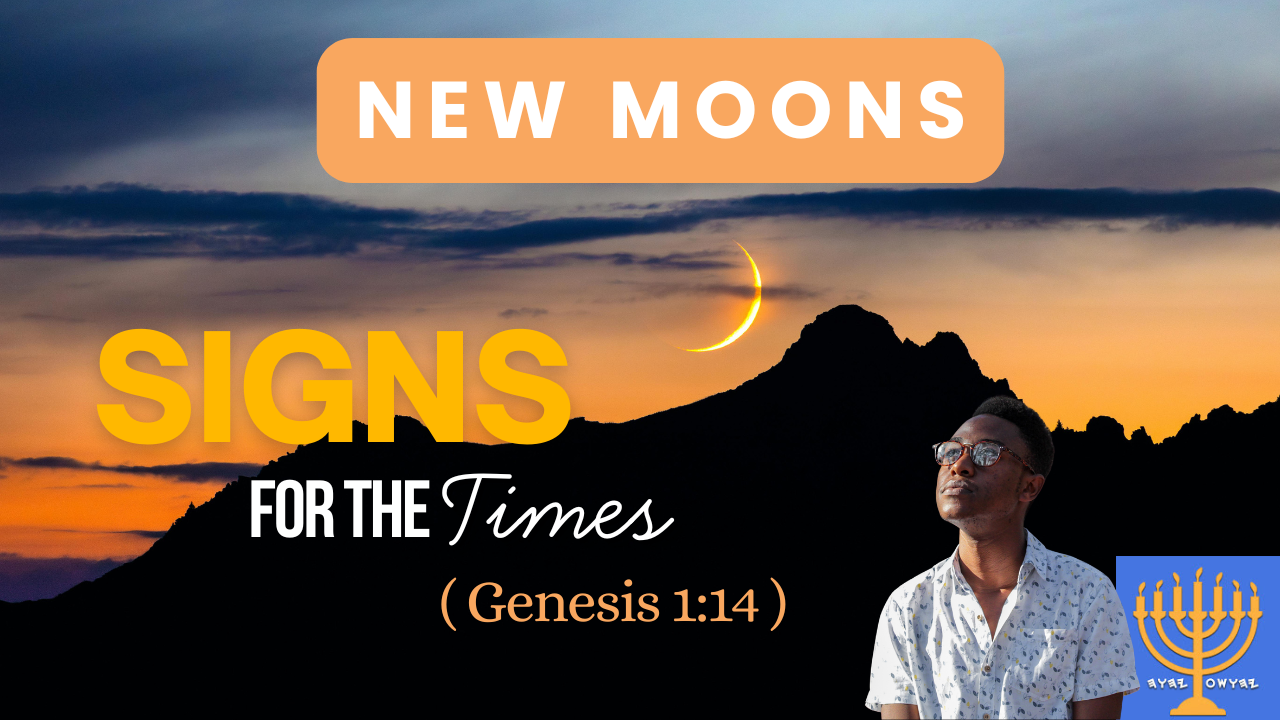
New Moons: Yahuah’s Time Markers in the Heavens
How the Moon Marks Biblical Months — and What Scripture Actually Requires
Every month, without fail, the moon disappears into darkness and then reappears — a thin sliver of light low on the western horizon just after sunset. Most people barely notice it. But for those walking by Scripture, that crescent is a signal: a new biblical month has begun. This is Rosh-ḤodeshH7218 + H2320 — the New Moon — and Yahuah placed it in the sky for exactly this purpose.
This article is not meant to be an exhaustive study. It is an introduction — a straightforward look at what the New Moon is, how it functions in the biblical calendar, and what it does and does not require of us. If you have ever wondered whether Rosh-Ḥodesh is like the Sabbath, whether you need to stop working, or simply how to acknowledge it in your home, this is a good place to start.
Yahuah Set It There on Purpose
The biblical calendar does not begin with a human tradition or a rabbinical ruling. It begins with creation. On the fourth day, Yahuah said:
“Let there be lights in the expanse of the heavens to separate the day from the night. And let them be for signsH226 and for seasonsH4150, and for days and years.”
— Bereshit / Genesis 1:14
The Hebrew word translated signs is ‘owthH226 — a signal, a beacon, a visible marker. The word translated seasons is mo’edimH4150 — appointed times, the same word used throughout Leviticus 23 for the feast days. The very lights Yahuah hung in the sky were designed to tell us when. The sun marks the day. The stars help orient the year. And the moonH3394? The moon marks the monthsH2320.
Psalm 104:19 puts it plainly: “He made the moonH3394 for appointed timesH4150.” The moon is not decorative. It is functional — a timekeeping instrument built into creation itself, visible to every person on earth regardless of where they live, what language they speak, or whether they own a calendar.
What Rosh-Ḥodesh Actually Is
RoshH7218 means head or beginning. ḤodeshH2320 comes from the root chadashH2318 — to renew or make new — and refers both to the new moon and to the month itself. Together, Rosh-Ḥodesh is the head of the new month: the first day, marked by the return of the visible crescent in the western sky after the conjunction.
This is important: we do not mark the conjunction — the moment the moon is completely dark and invisible. You cannot observe what you cannot see. Our ancestors had no telescopes or astronomy software. They watched the sky with their eyes. Months began when the crescent was seen. This is the pattern embedded in Genesis 1:14 — Yahuah gave us lights as signsH226, and a sign must be visible to serve its purpose.
What About Cloud Cover?
If clouds or near-horizon haze prevent a local sighting, we rely on credible regional reports from trusted observers. The date may occasionally be confirmed the following evening when visibility allows. The moon itself sets the timing — we simply watch for what Yahuah has placed in the sky.
If clouds or near-horizon haze prevent a local sighting, we rely on credible regional reports from trusted observers. The date may occasionally be confirmed the following evening when visibility allows. The moon itself sets the timing — we simply watch for what Yahuah has placed in the sky.
⚠ A Note on Modern Astronomy’s Definition
The term “new moon” in modern astronomical and popular usage refers to the conjunction — the phase when the moon is completely invisible, positioned between the earth and sun. This is the opposite of the biblical new moon. Searching online calendar tools, NASA resources, or popular astronomy apps will return conjunction dates, not crescent sighting dates. These are not the same thing. Keep this distinction in mind whenever you encounter the phrase “new moon” outside of a Scripture-based source.
The term “new moon” in modern astronomical and popular usage refers to the conjunction — the phase when the moon is completely invisible, positioned between the earth and sun. This is the opposite of the biblical new moon. Searching online calendar tools, NASA resources, or popular astronomy apps will return conjunction dates, not crescent sighting dates. These are not the same thing. Keep this distinction in mind whenever you encounter the phrase “new moon” outside of a Scripture-based source.
The Moon Marks Months — Not Sabbaths
One of the most important things to understand about Rosh-Ḥodesh is what it is not. The New Moon is not a weekly Sabbath, and it does not govern, reset, or replace the weekly seventh-day Sabbath cycle.
The Sabbath follows its own unbroken rhythm established at creation — six days of work, the seventh day of rest — independent of the moon
(Gen 2:1–3; Ex 20:8–11). These are two separate systems serving two separate purposes: the Sabbath marks the week; the New Moon marks the month. Scripture consistently treats them as distinct
(2 Kings 4:23; Amos 8:5; Isaiah 66:23; Ezekiel 46:1) — mentioned side by side precisely because they are different things.
New Moons mark the months.
The weekly Sabbath runs its own unbroken cycle — six days, then rest.
These are two different systems. Scripture never conflates them.
The weekly Sabbath runs its own unbroken cycle — six days, then rest.
These are two different systems. Scripture never conflates them.
Does Rosh-Ḥodesh Require a Work Stoppage?
This is perhaps the most practical question people ask, and Scripture gives us a clear and freeing answer: no — with one specific exception.
When Yahuah lists His appointed times and their requirements in Leviticus 23, He does not assign a monthly holy convocation or servile work prohibition to Rosh-Ḥodesh. The one New Moon that carries convocation-level requirements is the New Moon of the seventh month — Yom Teruah — which is treated as a full appointed time with its own specific commands
(Lev 23:23–25; Num 29:1). That is the exception, not the rule.
For the other eleven months of the year, Rosh-Ḥodesh is a day to acknowledge and honor — but it does not carry the same weight as the weekly Sabbath or the feast days. The passage in Amos 8:5 gives us a glimpse into how some in ancient Israel treated it — pausing from commerce out of a heart of reverence — but this reflects a voluntary devotion, not a commanded law binding on all households.
📖 What Scripture Shows Us
Leviticus 23 is Yahuah’s own calendar summary. Reading through it carefully, you will find that the monthly New Moon (outside of the seventh month) does not appear in the list of commanded convocations. Let the text speak for itself.
Leviticus 23 is Yahuah’s own calendar summary. Reading through it carefully, you will find that the monthly New Moon (outside of the seventh month) does not appear in the list of commanded convocations. Let the text speak for itself.
How to Honor Rosh-Ḥodesh in Your Home
Just because Rosh-Ḥodesh does not require a work-stoppage does not mean it passes by uncelebrated. There is a simplicity and beauty to acknowledging the new month — a moment to look up, give thanks, and remember that Yahuah is the One ordering our days.
Psalm 81:3 connects the shofar to the new moon: “Blow the shofar at the new moonH2320, at the full moon, on our feast day.” Some households blow the shofar, pray, sing, or read Scripture together to mark the beginning of a new month. These are meaningful expressions of worship that Scripture itself points us toward.
As an assembly, we aim to acknowledge each New Moon together — sharing the date on social media or by email, so households can mark it in step with one another. We follow one unified schedule, beginning each month with the first visible crescent, anchored to the Biblical New Year. That shared calendar is what keeps us walking together as one body in Yahuah’s appointed rhythm.
🕯 A Note on Candle Lighting
Some households choose to light candles as part of their Rosh-Ḥodesh prayer and acknowledgment — a beautiful personal practice. However, the menorah and its prescribed lighting belong to the sanctuary service
(Ex 27:20–21). Home candle lighting for New Moons is a matter of personal devotion, not a biblical command. We want to be careful, as always, to distinguish tradition from Torah.
Walking by the Moon Yahuah Made
The New Moon is one of the simplest and most accessible parts of the biblical calendar. No special equipment is needed — just clear skies and the willingness to look up. Every month, Yahuah gives His people a visible, recurring sign: the crescent appears, a new month begins, and time moves forward exactly as He designed it.
Learning to mark Rosh-Ḥodesh is not about adding religious burden. It is about walking in sync with the way Yahuah has ordered time — the way His people have always counted months, the way the feasts are anchored, the way Scripture makes sense when the calendar it assumes is the one you are actually using.
Start simple. Watch for the crescent. Give thanks. Blow the shofar if you have one. Pray with your household. Let each new month be what Yahuah always intended it to be — a sign in the sky that He is still ordering your days.
“He made the moon for appointed times; the sun knows its going down.”
— Tehillim / Psalm 104:19
This Is Not an Exhaustive Study
What you have read here is meant as an entry point — a foundation, not a ceiling. We encourage you to keep searching the Scriptures and to verify everything through the text itself. The biblical calendar is a deep subject, and there is much more to explore.
One caution worth naming: the word “new moon” means something very different in modern astronomy than it does in Scripture. Because of this, general internet searches — including AI-generated answers, popular calendar sites, and many YouTube teachings — can introduce confusion rather than clarity. These sources often reflect astronomical conventions or traditions that are not grounded in the Hebrew text.
For serious study, the most reliable tools are those that take you directly to the source: Hebrew lexicons, concordances, word studies in the original language, and works by vetted authors who handle the Scriptures carefully. The goal is always to let the Word define its own terms — so that we are going by what Yah says, and not any man.